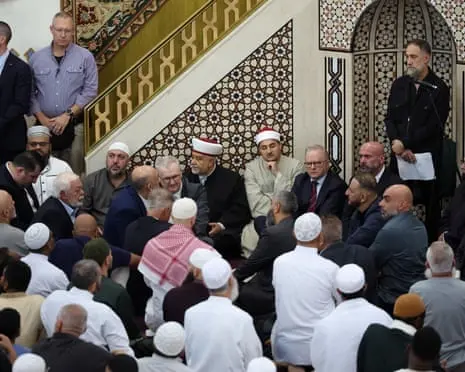
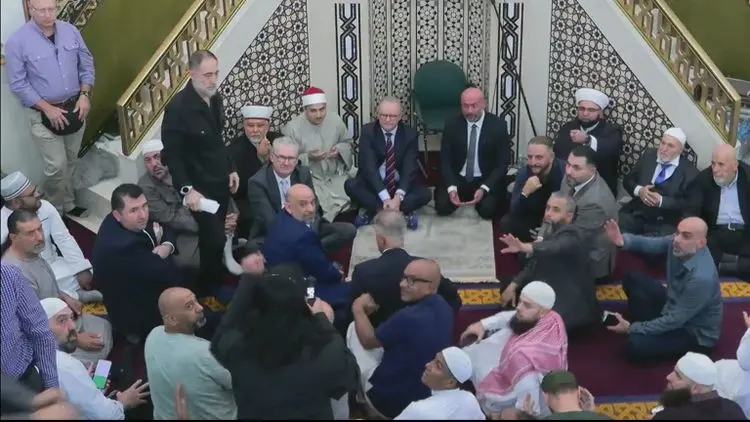
Tensions escalated sharply during Eid prayers at Lakemba Mosque when Anthony Albanese and Tony Burke were confronted by a wave of anger from a segment of the crowd, transforming a sacred gathering into a politically charged moment.
What was expected to be a peaceful and reflective religious occasion quickly shifted in tone as voices rose from within the congregation. Some attendees expressed frustration openly, with boos and harsh criticism echoing through the mosque’s courtyard during the high-profile visit.
Witnesses described a tense and emotionally charged environment, where the contrast between spiritual devotion and political dissent became strikingly visible. The incident unfolded rapidly, leaving both organizers and attendees grappling with the unexpected disruption.
Security personnel maintained a visible presence throughout the event, carefully monitoring the situation to prevent further escalation. Despite the intensity of the reaction, the gathering did not descend into chaos, and prayers were able to continue under controlled conditions.
For Anthony Albanese, the moment underscored the increasingly complex nature of public engagement in a divided social climate. Appearances that once symbolized unity are now often accompanied by heightened scrutiny and unpredictable responses.
Similarly, Tony Burke found himself directly exposed to the frustrations of a vocal group. The backlash reflected broader dissatisfaction that extends beyond a single event and into ongoing political debates affecting various communities.
Community representatives later emphasized the importance of preserving the sanctity of religious spaces. They called for respectful dialogue, noting that while dissent is a democratic right, its expression within places of worship requires careful consideration and sensitivity.
Political analysts have suggested that the incident reflects deeper underlying tensions within Australian society. Issues related to identity, policy direction, and international affairs have contributed to an environment where public reactions can quickly intensify.
The rapid spread of images and videos from the event amplified its impact significantly. Social media platforms became key channels for public reaction, with commentary ranging from strong condemnation to expressions of support for those voicing their concerns.
For many observers, the incident raised fundamental questions about the balance between freedom of expression and respect for communal traditions. It highlighted the challenges of navigating these values in a multicultural and politically diverse society.
Supporters of the government argued that leaders must engage directly with communities, even when facing criticism. They viewed the visit as a necessary effort to maintain dialogue and connection, despite the risks involved in such engagements.
Critics, on the other hand, pointed to unresolved grievances that they believe fueled the reaction. They argued that public outbursts are often symptoms of deeper issues that have not been adequately addressed through policy or communication.
Within the broader context of Australian multiculturalism, the event has sparked renewed debate about cohesion and inclusion. While diversity remains a defining characteristic of the nation, moments like this reveal the complexities involved in sustaining unity.
Religious celebrations such as Eid carry profound significance, making any disruption particularly impactful. When political tensions intersect with such occasions, the emotional resonance can be amplified, affecting both participants and observers.
Voices from within the Muslim community reflected a range of perspectives. Some condemned the confrontational behavior as inappropriate for a place of worship, while others defended the right to express dissatisfaction in visible and direct ways.
The response from Anthony Albanese following the incident is expected to play a crucial role in shaping the narrative moving forward. Clear communication may help address concerns and reduce further polarization.
At the same time, Tony Burke faces the challenge of engaging with affected communities while navigating the broader political implications of the event. His role will be central in efforts to rebuild trust.
Political strategists are likely to analyze the incident in detail, considering its implications for future public engagements. Adjustments to outreach strategies and messaging may be necessary in response to the reactions witnessed.
The situation also highlights the growing pressures faced by public figures in an era of constant visibility. Leaders are increasingly required to respond in real time to complex and emotionally charged situations.
For many citizens, the event serves as a reminder of the importance of constructive dialogue. Bridging divides will require efforts from both political leaders and community members to foster understanding and mutual respect.
As discussions continue across the country, attention remains focused on how similar situations can be managed more effectively in the future. Preventing escalation while respecting differing viewpoints remains a delicate balance.
In the end, what unfolded at Lakemba Mosque is not merely an isolated incident. It reflects broader societal dynamics that continue to shape the relationship between politics, religion, and public life in modern Australia.
The long-term impact of the event will depend on how stakeholders respond in its aftermath. Whether it leads to deeper division or renewed efforts toward unity will be determined by actions taken in the days and weeks ahead.