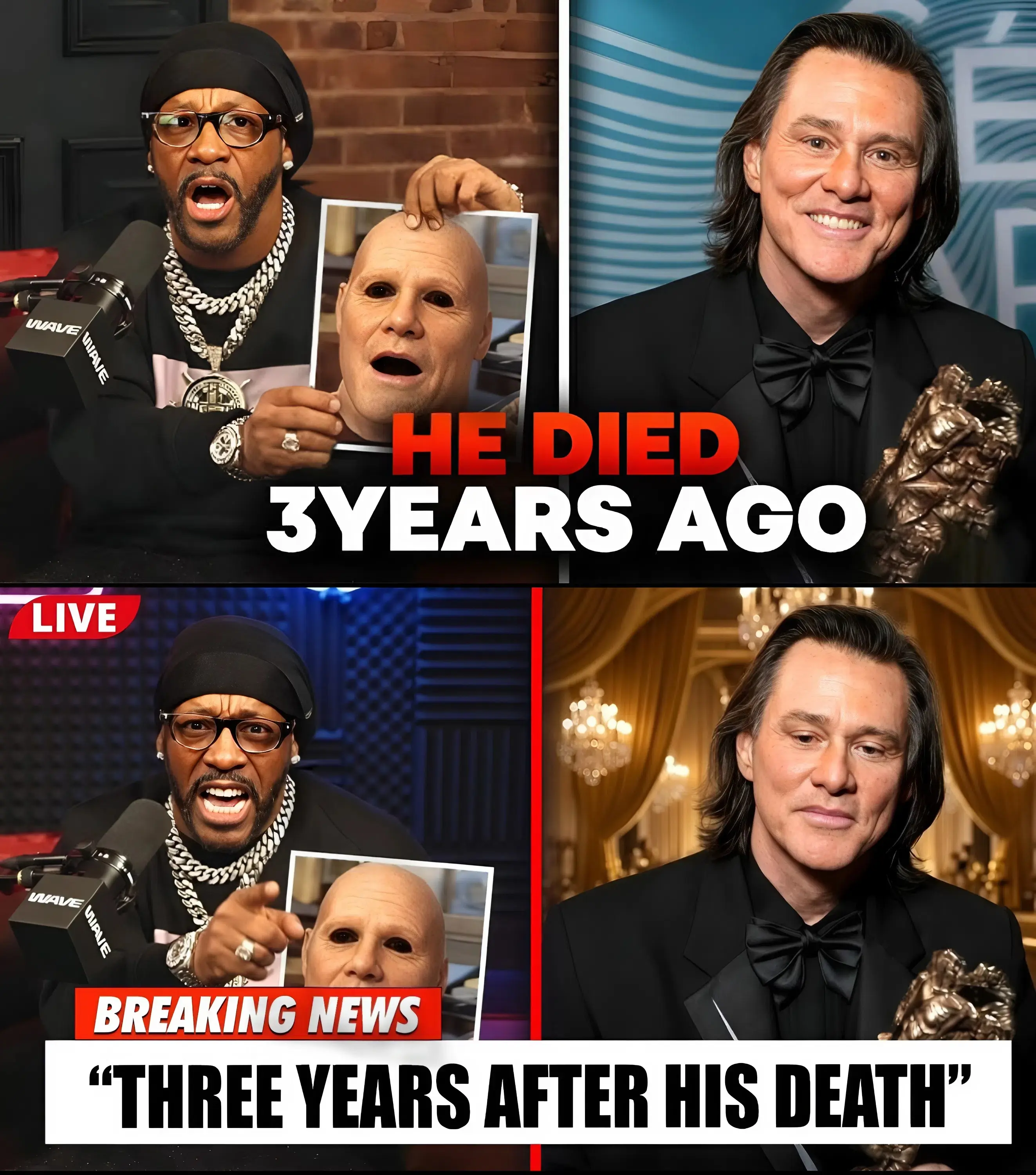
Katt Williams REVEALS Hollywood REPLACED Jim Carrey With His CLONE — a claim as explosive as it is controversial has sent shockwaves across the entertainment world, igniting fierce debate about identity, celebrity culture, and the extreme pressures of maintaining relevance in Hollywood. When Katt Williams publicly suggested that Jim Carrey had been “replaced,” he wasn’t just making a provocative statement—he was tapping into a growing unease among fans who feel disconnected from the familiar faces they once adored.
The speculation intensified following Jim Carrey’s recent appearance at the César Awards in Paris. Once celebrated as one of the most physically expressive performers in cinematic history, Carrey built his legacy on exaggerated facial movements, elastic expressions, and a raw, almost cartoonish emotional range. From his early comedic breakthroughs to his later dramatic roles, his face was not just recognizable—it was iconic. So when he appeared with noticeably smoother features and a more restrained expression, many viewers felt something was… different.

Social media quickly erupted with theories. Some pointed to cosmetic procedures, others to natural aging, and a more fringe segment leaned into conspiracy narratives involving clones and body doubles. While such ideas may seem far-fetched, they often emerge from a deeper psychological response. Fans are reacting not just to physical changes, but to a perceived loss of authenticity—an unsettling feeling that the person they grew up watching has somehow become unrecognizable.
Katt Williams’ remarks, though widely criticized, struck a nerve because they echoed a broader cultural anxiety. In an industry that thrives on perfection and reinvention, the line between natural evolution and artificial transformation can become blurred. Hollywood has long been associated with cosmetic enhancement, digital editing, and image control, creating a standard that often leaves little room for visible aging or imperfection. For many actors, especially those whose careers are tied to their physical expressiveness, this pressure can be immense.
Jim Carrey’s transformation, whether the result of personal choice, professional necessity, or simple aging, highlights this tension. His face, once a canvas of boundless expression, now appears more controlled, more polished. For some fans, this shift feels like a loss—not just of a look, but of a connection. It raises questions about what audiences truly value: the authenticity of a performer or the illusion of timelessness.
Experts in media psychology suggest that these reactions are not unusual. When a public figure undergoes a noticeable change, especially one that alters a defining characteristic, it can trigger a sense of dissonance. The brain struggles to reconcile the familiar with the unfamiliar, leading to speculation and, in some cases, conspiracy theories. In this context, the idea of a “clone” is less about literal belief and more about symbolic expression—a way of articulating the feeling that something essential has been lost.
Katt Williams, known for his unfiltered commentary and willingness to challenge mainstream narratives, has built a career on pushing boundaries. His statement about Jim Carrey can be seen as part of this broader pattern—provocative, confrontational, and designed to spark conversation. Whether one agrees with his perspective or not, it undeniably brings attention to the pressures faced by celebrities in an image-driven industry.
At the same time, it is important to approach such claims with critical thinking. There is no credible evidence to support the idea that Jim Carrey has been replaced by a clone or body double. What is far more plausible—and far more grounded in reality—is that he, like many others in the public eye, has navigated the complex landscape of aging, self-image, and professional expectation. Cosmetic procedures, lighting, makeup, and even camera angles can dramatically alter appearance, contributing to the perception of change.

The entertainment industry’s relationship with aging remains complicated. While some actors are celebrated for embracing their natural evolution, others face criticism or diminished opportunities as they grow older. This creates a paradox: audiences demand authenticity, yet the industry often rewards conformity to an idealized image. In this environment, even subtle changes can become magnified, scrutinized, and misunderstood.
Jim Carrey himself has, in the past, spoken openly about identity and the illusion of self, often in philosophical terms. He has described the concept of a fixed persona as a kind of performance, suggesting that what we see on screen is only a fragment of a much larger, more complex reality. In that sense, the current discourse surrounding his appearance takes on an almost ironic dimension. The man who questioned the nature of identity is now at the center of a debate about whether he is still “himself.”
Ultimately, the narrative surrounding Katt Williams’ claim reveals more about society than it does about Jim Carrey. It exposes the ways in which audiences project their expectations onto public figures, and how discomfort with change can manifest in dramatic and sometimes irrational interpretations. It also underscores the power of celebrity culture, where even the smallest shift can generate global conversation.
As the debate continues, one thing remains clear: Jim Carrey’s impact on entertainment is undeniable, regardless of how his appearance may evolve. His legacy is not defined by a single look, but by decades of performances that have left an indelible mark on audiences worldwide. And while Katt Williams’ comments may have reignited interest and controversy, they also serve as a reminder of the intense scrutiny that comes with life in the spotlight.
In a world increasingly shaped by images and perceptions, the question is not whether celebrities change—they inevitably do—but how we, as observers, choose to interpret those changes. Are they signs of loss, or simply evidence of time, growth, and the human experience? The answer may say more about us than it does about them.